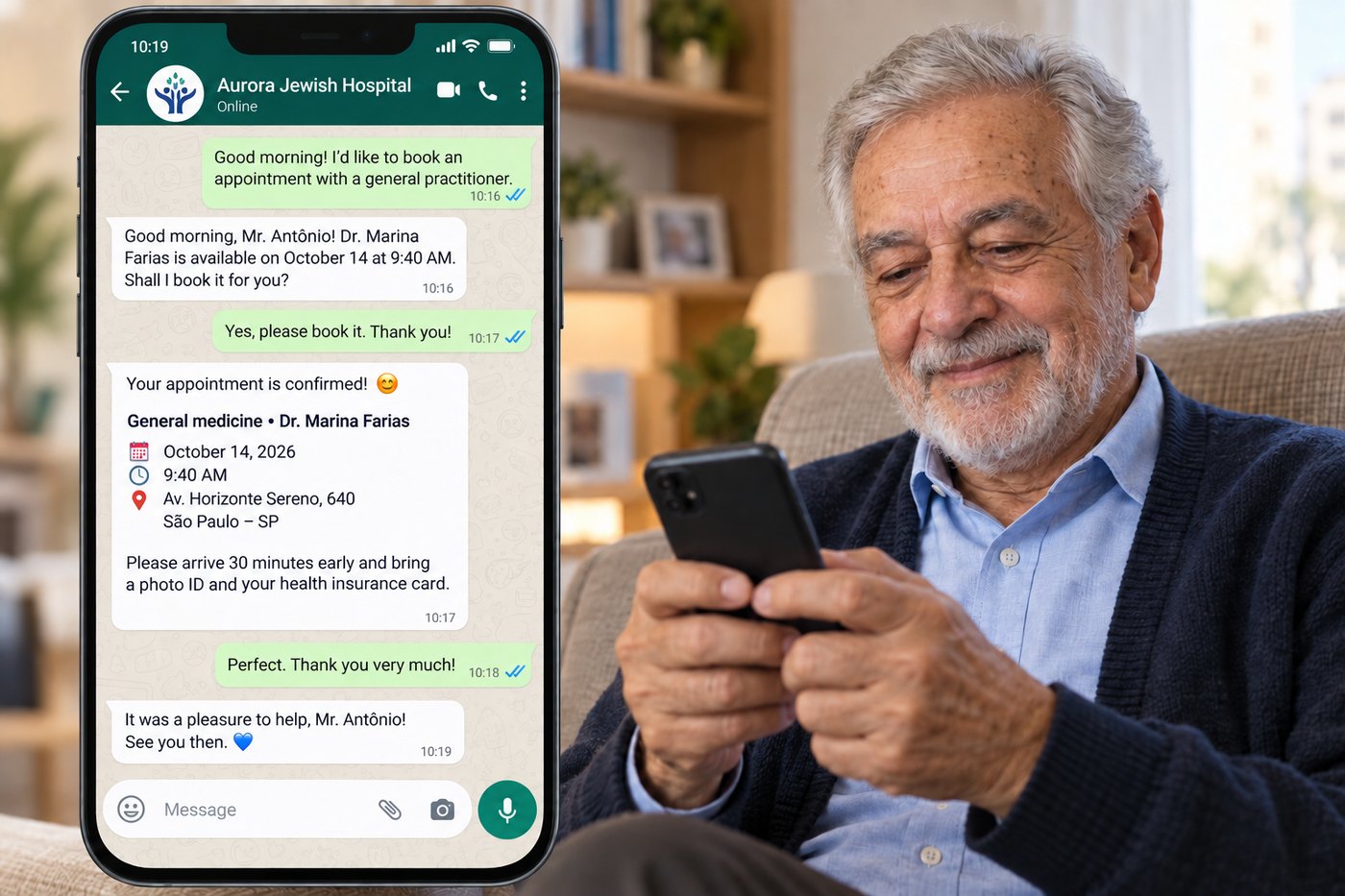
Hospital patient service on the official Meta WhatsApp
The number printed on the hospital card, on the website and on the sign above the front desk starts getting real answers. At eleven at night, on a Sunday morning, and in the hour when there is a line at the counter — the patient asks about fasting before the CT scan, about the plan card, about which floor a department is on, and gets an answer within the minute.
One official, verified number, with several agents and several people answering at the same time. The agent gives no clinical guidance, and it calls a person the moment the subject leaves what it knows.
The foundation
An official number, not a handset in the front-desk drawer
Almost every hospital already answers on WhatsApp — on one phone, one person at a time, with no history and no guarantee the number is still up tomorrow. The difference is not the app. It is where the number is registered and what can be wired to it.
A front-desk handset on WhatsApp Web
One device and one person at a time: the second message waits for the first to finish
An unverified number, exposed to a block at any moment
History trapped in the phone — whoever leaves the team takes the conversation along
Wired to nothing: not the schedule, not the patient registry, not an audit trail
Bulk sending outside Meta's policy takes down the very number the hospital advertises
Nobody knows how long the patient waited, or how many gave up halfway
An official number on the Meta Cloud API
Several people and several channel agents on the same number, at the same time
A verified business profile, with the hospital's name, picture and description, visible before the patient writes
The conversation lives in the platform console: full history, with every takeover logged by owner and time
The agent gets real tools — schedule, patient registry, Knowledge Vault — instead of a fixed script
Outside the 24-hour window only a Meta-approved template goes out, and the platform refuses anything else
Every conversation carries a subject, a response time and an outcome, and becomes a number on the daily dashboard
Who runs the channel
Hal-AI is a Meta Business Partner
The hospital's number is activated through Meta's own authorization flow, on the official WhatsApp Business Cloud API. There is no emulator, no handset wired to a server, no automation running around the policy — what there is, is a business account owned by the institution and operated by the platform.
A verified profile, with the hospital's name and identity
Several agents and several operators on the same number
Approved templates for speaking outside the 24-hour window
Meta policy compliance as a rule of the product, not as a recommendation
The 24-hour window, in plain terms
Who speaks first changes everything
As long as the patient wrote in the last 24 hours, the conversation is free: the agent answers whatever is needed, in whatever format is needed. Once those 24 hours pass, nothing goes out except a Meta-approved template — which is why reminders, confirmations and "your result is ready" notices are designed as templates from day one.
When the agent cannot answer right now, it does not vanish: the conversation is flagged, and the hospital picks it back up through the permitted path. What the platform never does is send around the rule to save one interaction — because the price of that is the number on the sign at the entrance.
The window is not a Hal-AI limitation. It is Meta's rule, and the product was designed to fit inside it.
Anyone who has never read a hospital's message inbox pictures a flood of clinical cases. It is not that. Most of what arrives is operational, repetitive and perfectly answerable — and it is exactly what keeps the front desk busy all day.
Exam prep
“Can I eat beforehand?”
Whether to fast and for how long, whether water is allowed, whether the exam uses contrast, which medications usually need the team to weigh in first, how early to arrive. Every exam has its own prep, and it is the department's Knowledge Vault that answers — not some generic text off the internet.
Health plan and plan card
“Do you take my plan?”
Which payers — the health plan operators the hospital is contracted with — it accepts, which product inside the payer, whether that procedure is covered, whether prior authorization is needed. The agent checks the official list of contracted plans instead of repeating what someone at the counter remembered.
Documents
“What do I need to bring?”
Photo ID, plan card, doctor's request, approved authorization form, a previous exam, a companion when the procedure requires one. The list changes by type of visit, and the person who shows up without the right paper goes home — the wasted trip is the single biggest source of complaints.
Getting there
“Where do I park? Which floor?”
Which block to enter, basement access, the service elevator that is closed on weekends, which reception desk handles each specialty. In a hospital complex with more than one building, this alone is an entire line at the entrance counter.
Visiting hours
“What time can I visit?”
Hours by inpatient unit, how many companions, the rule for children, the rule for the ICU, what can and cannot come in. A question that arrives in bursts late in the afternoon, right as the front desk is closing.
Test results
“Is my result ready?”
The agent checks the state of the report — ready, under review, expected on a given day — and says where to pick it up or how to access it. What it does not do, under any circumstance, is read the result and explain what it says.
Referral and authorization
“Was my authorization approved?”
The state of the authorization, what is missing, where the patient was referred, which department asked for what. The same subject seen from the inside is what shows up in billing and denials — here it is only the part the patient needs to know.
Department phone
“Who do I talk to?”
The extension for the outpatient clinic, for imaging, for patient billing, for patient relations. The agent hands over the shortest path — and when the subject is already clear, it opens the ticket itself instead of sending the patient off to make a call.
Booking and rescheduling
“I want to change my appointment day”
It can be settled on the same number, in the same conversation, with the hospital's official schedule being changed through the API. How that works underneath — slot offers, waiting list, active confirmation — has a page of its own: appointment booking.
One whole conversation
Fasting, at eleven at night
This is the conversation that repeats most in a hospital with a large outpatient clinic, and the one that costs the most when it does not happen: the patient who did not know about the fast arrives and the exam is lost — the slot disappears from the schedule, the equipment sits idle and the specialty's waiting list grows.
Notice three things in the conversation beside this text. First: the agent answers the prep using the data of that person's booked exam, not a general rule. Second: when the question turns into medication, it stops — and says that it stopped, instead of guessing. Third: it does not hand back a phone number, it routes the case to the department and sets out when the answer will come.
Knows by heart what sits in the department's Knowledge Vault: prep by exam, documents, hours, campus map, companion rules.
Looks up live what only the system knows, through the tools it was given — api_get_exam_prep, api_get_accepted_plans, api_get_exam_status.
Remembers the patient in the next conversation: the exam they had, the question still open, the department that owed them an answer.
Stops where it does not know and says it is going to call someone, with the full history going along.
H
Hospital · Imaging online
Good evening. I have a CT scan tomorrow at 7. Can I eat?23:04
Good evening! For tomorrow's contrast CT at 07:00, you need to fast for 4 hours — no coffee, no tea, nothing with sugar. Plain water is fine.23:04
And my blood pressure medication, do I take it?23:05
That part I don't answer — I can't advise you to stop or keep taking medication. I've left your question with the imaging department and they'll reply right here from 07:00. If anything gets worse tonight, go to the emergency room.23:05
Voice message sent by the patient, eleven seconds long.▶0:11
I understood your voice message: you want to know what to bring. Photo ID, your health plan card and the doctor's request. For the contrast we also ask for a creatinine test from the last 12 months — if you had it done here, I'll find it and confirm by early morning.23:06
And which floor is it on?23:07
Imaging is on the 2nd floor of Block B. You come in through the main reception, and the covered parking has direct access from the basement. Please arrive 20 minutes early.23:07
H
Hospital · Outpatient front desk online
Do you take my plan?09:11
We work with 14 payers. Tell me the plan name and the product type, or send a photo of your plan card, and I'll check coverage for a cardiology appointment.09:11
I'll send a photo of the card.09:12
I received the image and could read the payer name and the product. That plan is one the hospital works with, and cardiology is on the list of covered specialties.09:12
For the appointment you'll bring photo ID, your plan card and the doctor's request. Your plan requires prior authorization: the form is requested at the outpatient reception, on the ground floor, and it comes out the same day.09:13
And what if I want to come as a self-pay patient?09:14
We take self-pay too. I don't quote prices here — the private billing desk does. Would you like me to call someone from there now?09:14
Yes, please.09:14
Done. Someone from that desk will take over this conversation in a moment, with everything we talked about in view. I'll stay quiet until they're finished.09:15
Example conversations. What the agent can answer depends on the Knowledge Vault and on the tools each hospital configures.
Text, audio and image
The patient sends a voice message. The agent understands it.
A large share of the people who contact a hospital are over 60, in a hurry, or on a bus. That person does not type: they hold down the microphone and talk. And when the subject is a piece of paper, they photograph the paper.
Audio coming in. The agent transcribes it, understands the request and answers — in text, or with a short voice message if that is what the person prefers. Nobody has to sit through the recordings at the end of the day.
Images coming in. A photo of the plan card, the doctor's request, the authorization form, the receipt. The agent reads what is written there and uses it in the answer: the payer name, the request number, the date.
Text, exactly as it comes. A sentence broken into five messages, abbreviations, typos, a question dropped in the middle of another subject. An agent with memory follows along; a decision tree jams.
Media going out. When it helps, the agent sends back the block map, the document checklist as a PDF or the appointment receipt — inside the 24-hour window, in the same conversation.
One explicit limit. A photo of an exam, a report or a lesion is not read as clinical information. The agent says it does not assess medical images and takes the case to the team.
It is the same memory and the same context the platform uses on every other channel: the patient who sent a voice message yesterday and typed today is still the same person, with the same history, without repeating what they already said.
In an operation staffed by people, audio is the worst format there is: someone has to stop, listen to the whole thing and type up a summary. Here it is resolved on the way in, and what stays on record is the text of what was asked — searchable, countable and auditable like any other message.
One number, several agents
Front desk, imaging, billing and patient relations answering together
A hospital does not have a single subject, and forcing everything into one bot produces an agent that knows a little about a lot. On the platform, the official number hosts several channel agents — each with its own personality, Knowledge Vault and tools — and the intent of the message decides who answers.
Agent 1
Outpatient front desk
This is the number's front door. It talks about specialties, accepted health plans, documents, hours, campuses and access. When the conversation is about booking, it acts on the official schedule; when it belongs to another domain, it hands over to a sibling agent with the history attached.
The prep specialist. Fasting by exam type, contrast, how long to stay, what to bring, when the report is ready and where to pick it up. It is the most technical Knowledge Vault on the number — and also the strictest about the limit: it explains prep, it never touches clinical management.
api_get_exam_prepapi_get_exam_statusAgent 3
Patient billing
It answers the questions of someone who has already been seen: whether the authorization went through, what the payer covered, what was left as a co-payment, which document is missing to close the case. It does not quote amounts on its own — it routes to the department the moment the subject turns into a negotiation.
api_get_claim_statusapi_get_authorizationAgent 4
Patient relations
The ouvidoria desk — the hospital's formal patient-complaint channel. It takes the complaint, files a ticket number, states the deadline and follows it through to the answer. Dissatisfaction surfaces while it is still a conversation — not later, as a public review or a formal complaint with a clock running.
api_post_complaintapi_get_complaint_ticket
To the patient it is one number. Underneath it is four specialists, and none of them has to carry the others' manual.
Hal-AI · Agents on the official numberIntent routing
Hospital's official number4 active agents · intent routing · takeover availableEdit routing
Search agents, tools or subjects…Active 4With memory 4Writing to systems 2Official number · main campus
Configuration of the selected agent
AgentOutpatient front desk · front door of the official number
PersonalityWarm and to the point; addresses the patient directly; never opines about healthThe personality text is where the hospital's rules go in — in language, not in a flowchart node.
Knowledge Vaultcontracted health plansdocuments by visit typecampus mapvisiting rules
Toolsapi_get_accepted_plansapi_get_facility_infoapi_get_schedule_availabilityapi_get_patient_chartWhatever was not handed to the agent does not exist for it. The patient chart tool is off in the default configuration.
Long-term memory On · remembers the previous exam and the open item
Intent routing — latest messages
Front desk → Imaging “patient asking about fasting for tomorrow's CT”prep answered in the same chat api_get_exam_prepansweredFront desk → Patient billing “wants to know if the authorization went through”authorization state checked api_get_claim_statusansweredImaging → human queue “asking whether to stop a medication”outside what the agent may answer in the team's queue
One number, four agentsthe handover happens inside the same conversation, without the patient being sent to another numberhistory preserved
Screen of the agent configuration. The hospital is the one who defines personality, Knowledge Vault and tools — and each tool is declared one by one, with no implicit access to anything. The controls are in integrations and security.
When the agent calls a person
Handoff and takeover, without the conversation starting over
The most fragile moment in any automated service is the handover to a person. It is where the patient usually repeats everything again, gets another number to call, and gives up. Here the conversation does not change place: it changes owner.
1
The agent decides to call
There is no global escalation rule: each agent decides, based on the personality and the tools it was given — including the tool that transfers to a human. An explicit request from the patient, a subject outside the Knowledge Vault, a sign of urgency and a sensitive case are the typical triggers in a hospital.
2
The card lands in the right queue
The conversation becomes a card in the department's queue — front desk, imaging, billing, patient relations — with a summary of what has been handled, the subject classified and the full history attached. Nobody receives a conversation without context.
3
A person takes over and the agent pauses
The moment the card is assigned to an operator, automatic replies in that chat are paused. There is no agent and person talking at the same time. Whoever takes over is logged, by name and time.
4
Close it, and the agent comes back
When the interaction is closed, the conversation returns to the agent with everything the person wrote. If the patient comes back tomorrow, the subject picks up where it stopped — including whatever the human agreed with them.
Hal-AI · Service inboxHuman takeover
Search conversations by name or subject…Department queueMy conversationsClosed todayQueue · Imaging
Handoff requested by the agentreason: question about medication · outside what the agent may answerwaiting for an operator
Subject outside the Knowledge Vault
PV Patient · CT scan tomorrow
handoffImagingarrived 23:05
Already answered by the agent: 4-hour fast, documents and block location. Open: whether to keep taking the blood pressure medication.
history attachedaudio transcribedbooking tomorrow 07:00
in queue for 8 minTake overOpen history
AI paused automatically — conversation taken over by Marina (Imaging)Release to AI
On close, the agent resumeswhatever the operator wrote goes into the conversation's memory and counts for the next contactlogged
What does not change
The agent decides when to escalate. The hospital keeps control.
The agent chooses the moment to call a person, but it does not choose what it is allowed to do. Tools are declared one by one in its configuration, and whatever was not handed over does not exist in its universe. The supervisor sees the open chats per operator, reassigns the card and closes the interaction whenever needed.
Every takeover is logged with owner and time
While the card belongs to a person, the agent stays paused in that chat
Closing hands the conversation back to the agent, with the whole history
Queues by department, with priority and waiting time in plain sight
In a hospital, the agent that never calls anyone is more dangerous than the agent that calls too often. That is why the indicator that matters is not “how many conversations the agent passed to the team”, but “how many it passed for the right reason, and how long the person waited afterwards”. Both are on the daily dashboard, in dashboards and indicators.
Service optimization
What changes in the human queue
Booking, confirming and answering on its own, the agent takes off the human queue the question that repeats three thousand times a month. The contact center that absorbs that volume today gets much smaller, and what is left for a person is the case that needs judgment — the confused patient, the angry one, the stuck authorization, the family that needs someone on the other end.
The example hospital
The size considered on this page
A mid-to-large hospital network · 28 outpatient specialties · around 60,000 outpatients a year · roughly 2,500 appointment slots offered per week · an official WhatsApp number with about 23,000 conversations a month · 14 contracted payers.
Hal-AI · Service on the official numberCurrent month · all campuses
SquadsAgentsServiceCRMCopilot
Conversations this month on the official numbersubject, response time and outcome · 23,000 conversations in the periodExport PDF
Search by subject, queue or agent…Current month 23,000No human 78%With handoff 22%Official number · all campuses
Conversations by subject — current monthsource: channel dashboard
Operational question Action on the official schedule Status lookup Complaints and other
Sum for the period — 5,290 + 4,600 + 4,140 + 3,450 + 2,760 + 2,760 = 23,000 conversations
Outcome across the 23,000 conversations of the month
Answered within 30 seconds92%Resolved with nobody from the team stepping in78%Arrived outside front-desk hours41%Passed to a person22%
Response time and resolution by subject
Conversations this month by subject, with the median and the 90th percentile of time to first reply and the share resolved without a person stepping in. No column carries clinical information or patient identification.
Results and patient relations hand off on purposethese are the two subjects where the agent is instructed to call the team — which is what pulls the p90 upagent rule2,760 + 2,760 = 5,520 conversations in subjects with a planned handoff
78%of conversations resolved with nobody from the team stepping in
−76%transfers to the front desk
−45%interactions in the human queue each week, for the same conversation volume
What you are looking at
A whole month of the channel on one screen
The month's 23,000 conversations broken out by subject, with the median and the 90th percentile of time to first reply and the share that ended without anyone from the team stepping in. The sum of the parts is printed under the chart and in the table footer: 5,290 + 4,600 + 4,140 + 3,450 + 2,760 + 2,760 closes at 23,000.
The gain
The median is seconds, not shifts
At a 6-second median and 22 seconds at p90, an operational question stops being a case to work and becomes an answer. The 41% that arrive outside front-desk hours — overnight, weekends, the lunch break — simply went unanswered before: they turned into a phone call the next day, or a no-show at the exam.
Only at Hal-AI
Notice what the screen does not show
No patient name, no clinical data, no health information. The aggregate panel works with subject, time and outcome — identification stays inside the conversation, under access control, and never reaches the management view. And the share that hands off is not hidden: 22% is a quality indicator, not a failure.
The other side of the counter
The patient experience is measured too
Channel satisfaction sits at 4.6 out of 5, service NPS moves from +31 to +58 and the classic complaint — “I can't get hold of the hospital” — drops by 68%. This is not a feeling: it is the survey the agent itself sends at the end of the conversation, counted alongside everything else.
The effect on the structure
The front desk needed for the same volume gets smaller
The post that existed to repeat opening hours and reconfirm appointments is no longer needed; whoever stays handles the complex case, the stuck authorization and the patient who needs someone nearby. Doubling the volume of conversations also stops meaning doubling the front desk. The effect on the schedule — capacity, no-shows and waiting lists by specialty — is in schedule and capacity.
These numbers arrive ready every day: a Squad wakes up, reads the systems, writes the document and sends it. How the agent writes the report →
Transparency
What the agent will not answer
In a hospital, the limit is the product. A channel that answers everything is a channel that will one day answer what it should not — and it is better to say this before the contract than after.
🛡️
No clinical guidance, no diagnosis, no prescription
The agent does not assess symptoms, does not suggest a hypothesis, does not recommend treatment, does not opine about medication and does not say whether something is serious. It handles what is operational: prep, health plan, documents, hours, location, authorization and report status. Any clinical subject goes to the human team with the conversation context attached.
📄
It does not interpret exam results
It tells you the report is ready, when it will be ready and where to pick it up. It does not read the content of the report to the patient, does not explain reference ranges and does not comment on images. If someone sends a photo of a result asking for an explanation, the answer is that this is for the doctor — plus the path to the team.
🙋
It does not handle emergencies — it points the way and shortens it
When a message carries a sign of urgency, the agent stops the operational conversation right there, tells the person to go to the emergency room or call emergency services, and hands over the shortest path to a human: a card at the top of the queue, without waiting its turn. It never tries to assess how serious the description is in order to decide whether the urgency is real.
🔒
It does not handle health data by default
Patient charts, clinical history and exam results are sensitive personal data under the LGPD, Brazil's data protection law. The default configuration does not reach them: the patient chart tool shows up switched off on the agent's configuration screen. Any integration with a clinical system depends on a specific project, with purpose, legal basis, access scope and responsibilities defined in the contract before any connection. The detail is in integrations and security.
⏱️
It does not speak outside Meta's rule and it does not invent numbers
Once 24 hours have passed since the patient's last message, only an approved template goes out — and the platform refuses a send that falls outside that, instead of gambling with the hospital's official number. In the same way, while a system is not connected, the agent states explicitly that the figure is a simulation. It never claims to be integrated with a system it is not.
H
Hospital · Outpatient front desk online
I've had a bad chest pain since just now. Is it serious?02:18
I don't assess symptoms and I can't tell you whether it is serious. Go to the emergency room now, or call emergency services. The hospital's emergency room is open 24 hours, with its own entrance on the side of Block A.02:18
I've already put this conversation at the top of the on-call queue. If you'd rather talk to someone here while you get organized, just reply “talk to someone”.02:18
The urgency reply is the only part of the script that does not depend on the Knowledge Vault: it is the same in every agent on the number.
Not necessarily. The number the hospital already advertises can be migrated to a business account on Meta's official Cloud API, through Meta's own authorization flow. What changes is where it is operated: instead of a handset with WhatsApp Web open, it becomes a channel with several agents, several operators, full history and an audit trail.
While the number is migrating, nothing is sent around the policy — Hal-AI is a Meta Business Partner, and compliance with Meta's rules is a condition of the product, not a recommendation.
Does the agent answer the patient's clinical questions?
No. It does not assess symptoms, does not suggest a diagnosis, does not recommend treatment, does not opine about medication and does not interpret exam results. What it answers is operational: exam prep, accepted health plans, required documents, location, visiting hours, report and authorization status, department phone numbers.
When the subject turns clinical, it says it cannot answer, routes the case to the team with the history attached and, on any sign of urgency, tells the person to go to the emergency room and puts the conversation at the top of the human queue.
Can the hospital message the patient first?
Yes, through a Meta-approved template. As long as the patient wrote in the last 24 hours, the conversation is free. Once that window closes, any message started by the hospital has to go out in a previously approved format — that is how appointment reminders, "report ready" notices and active confirmation work.
The platform refuses a send that does not fit the rule, rather than trying to work around it. The hospital's official number is worth more than one saved message.
How many agents fit on the same number?
As many as the operation needs. Each channel agent has its own name, personality, Knowledge Vault and tools, and the intent of the message decides who answers. A common design is the outpatient front desk as the front door, with imaging, patient billing and patient relations behind it.
To the patient it is still one number: the handover happens inside the same conversation, with no transfer to another contact and no repeating what has already been said.
Does the front desk lose control of the conversation?
Quite the opposite. Any authorized person takes over any conversation at any moment: the instant the card is assigned, the agent pauses in that chat, and there is no agent and human talking at the same time. The takeover is logged with owner and time, and the supervisor sees open chats per operator, reassigns the card or closes the interaction.
On close, the conversation goes back to the agent with everything the person wrote — including whatever they agreed with the patient.
Bring us the question your front desk repeats the most
Tell us which conversation your hospital repeats every day — exam prep, health plans, documents, which floor, visiting hours. We design the agent that handles that conversation on the official number together with you, with the Knowledge Vault and the tools it requires.